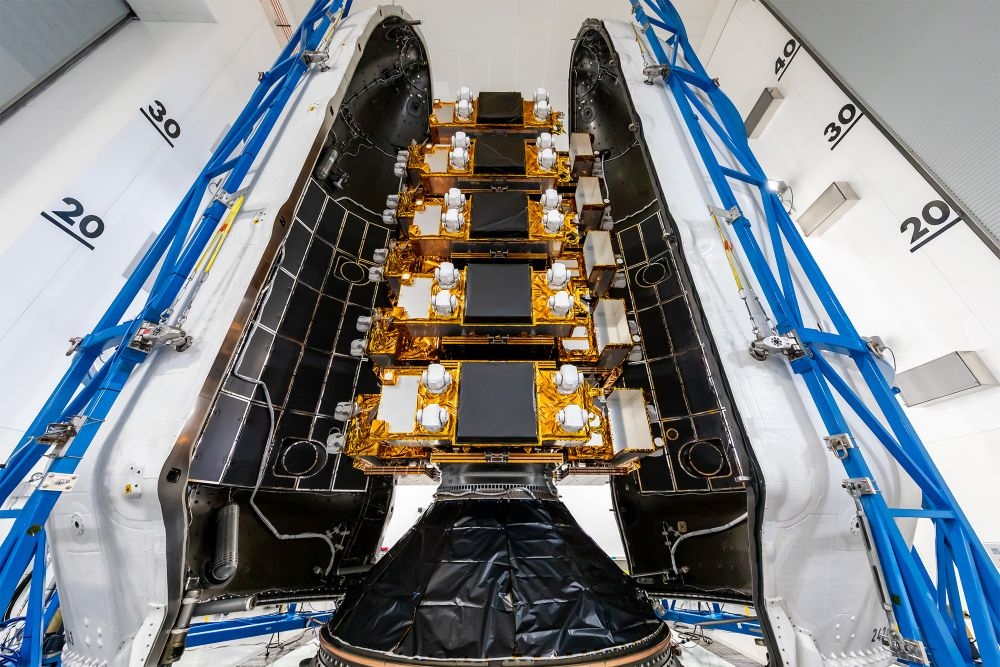
Northrop Grumman desplegó con éxito sus primeros 21 satélites de comunicaciones para la Agencia de Desarrollo Espacial de EE. UU. Estos dispositivos que forman parte de la red en órbita baja de la Arquitectura Espacial de Combate Proliferada (PWSA, constituyen el sistema vital para transmitir datos de empleo táctico y operacional, así como alerta temprana de misiles, además de extender la red de datos Link 16 hacia el espacio para mejorar la conectividad en general. Al distribuir las comunicaciones en múltiples plataformas, el sistema es más resiliente frente a interrupciones. Se estima el lanzamiento de un segundo grupo de 21 satélites y decenas de naves adicionales en los próximos 6 meses. En total, los contratos de la empresa abarcan cerca de 150 satélites para comunicaciones y rastreo, cuyas entregas están programadas para 2028.
Northrop Grumman has launched and deployed its first 21 communications satellites for the US Space Development Agency’s (SDA) Tranche 1 Transport Layer, part of a military network being built in low Earth orbit.
The satellites will relay tactical information between military forces and carry data from spacecraft that detect and track missiles.
Deploying the satellites is expected to expand communications capacity within SDA’s Proliferated Warfighter Space Architecture (PWSA), which spreads these functions across a large constellation.
The Transport Layer provides the architecture’s communications backbone, moving information between satellites and military users with minimal delay.
Separate missile-warning and tracking satellites collect sensor data that the network can then pass to forces on the ground, at sea, or in the air.
Northrop Grumman’s satellites are designed to extend Link 16 into space.
The military data network allows participating forces to exchange tactical information, and satellite connections are intended to expand its reach.
Distributing communications across multiple spacecraft is also intended to make the network more resilient to disruption and reduce dependence on individual satellites.
A second group of 21 satellites will follow, and several dozen additional company-built PWSA spacecraft are scheduled to reach orbit over the next six months.
Satellite Programs
Northrop Grumman’s SDA orders cover around 150 satellites across Tranches 1, 2, and 3, including more than 30 spacecraft dedicated to missile warning and tracking.
Those sensor satellites will feed data into the Transport Layer for distribution to military forces.
The company is also pursuing a separate mission in geostationary orbit.
Last month, the US Defense Innovation Unit and Space Systems Command awarded Northrop Grumman and True Anomaly contracts to build prototypes that can observe other spacecraft.
Known as GHOST-R, the effort supports the US Space Force’s RG-XX program and seeks to improve monitoring of potential threats to US satellites.
It combines maneuverable commercial platforms with electro-optical sensors to examine nearby objects from space, addressing limitations in ground-based observations.
Operational prototypes are due by 2028.
Fuente: https://thedefensepost.com