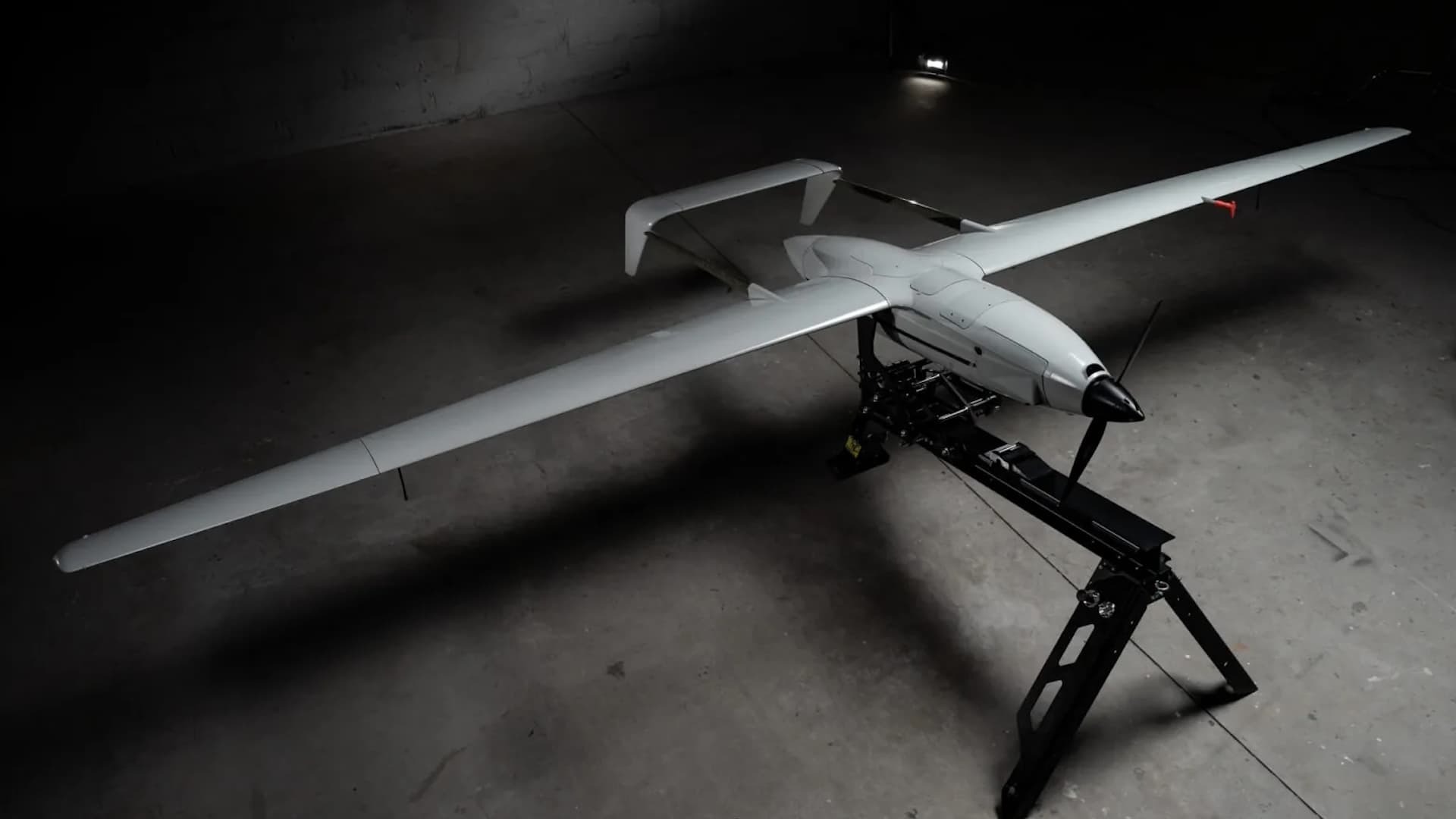
La empresa ucraniana Skyeton se especializa en el desarrollo y producción de drones UAS destinados a misiones de exploración y reconocimiento (ISR), siendo su producto más conocido el Raybird. Este UAS emplea un motor de combustión interna (CIE) lo que le otorga una autonomía de 28 hs. Aprovechando las características del sistema, la empresa desarrolló una nueva versión del Raybird, que emplea un motor híbrido “Hidrógeno – Eléctrico”, reduciendo a valores insignificantes sus firmas térmica y acústica, lo que incrementa su sigilo y dificulta la detección por parte de los sistemas sensores enemigos. El nuevo Raybird fue rediseñado completamente, el hidrógeno va en cartuchos intercambiables que alimentan al motor eléctrico y esto le otorga una autonomía de 12 hs, pudiendo llevar una carga útil de 10 kg de sofisticado equipamiento ISR. El sistema ya se encuentra desplegado en misiones de combate en Ucrania.
Ukraine has sent a hybrid hydrogen-powered drone into combat for the very first time. Drone manufacturer Skyeton announced that a variant of its Raybird drone was recently deployed in an active war zone by the Ukrainian Armed Forces.
According to the drone firm, the Raybird variant was modified to accommodate a new fuel system and to distribute weight for larger hydrogen fuel tanks. The electric propulsion version has a key advantage: its lower heat signature makes it particularly well-suited to reconnaissance missions.
Skyeton’s ‘completely redesigned’ Raybird
The standard Raybird, which runs on an internal combustion engine (ICE), allows for a flight endurance of over 28 hours, Skyeton explained in a press statement. The firm noted that the hybrid version used by the Ukrainian Armed Forces has a shorter endurance of 12 hours, though it is working to increase this to 20 hours.
“By utilizing hydrogen-electric propulsion, the platform offers enhanced operational efficiency and environmental benefits for both defense and civilian applications,” Skyeton said in the statement.
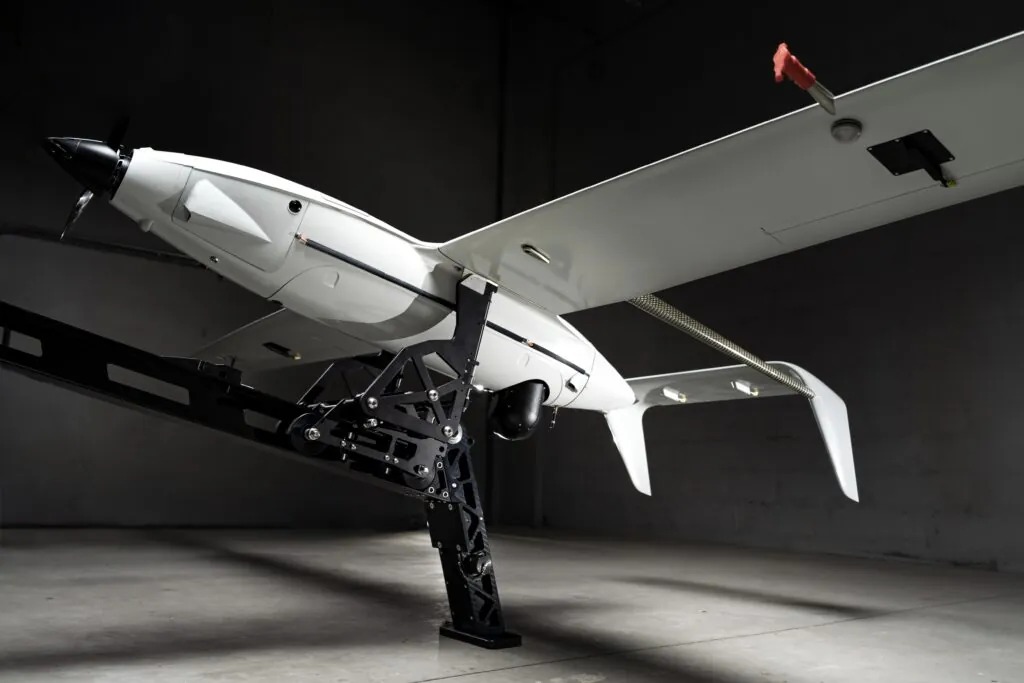
“We have converted two years of laboratory testing into a new aircraft concept: it is the same class and weight, but a completely redesigned concept based on electric propulsion,” added Skyeton CEO Roman Knyazhenko.
During those two years of R&D, Skyeton claims to have resolved issues related to climate resilience, hydrogen permeability, and infrastructure and logistics.
The modified Raybird uses hydrogen to generate electricity, which powers electric motors for thrust. Hydrogen is supplied via interchangeable cartridges. The drone has a cruising speed of 68 mph (110 km/h). It has a takeoff weight of 51 lb (23 kg), a wingspan of 15 ft (4.7 m), and a payload capacity of roughly 22 lb (10 kg). The hybrid version specifically is quieter than its ICE counterpart. It also has a lower heat signature, as well as a higher operational altitude range.
The hybrid Raybird’s ‘negligible thermal signature’
According to Skyeton, the Raybird is a reconnaissance drone. It is deployed in active war zones, but is not used for direct combat. Instead, it carries radar and surveillance sensors.
In this context, the hybrid version’s lower heat signature is particularly useful. According to Skyeton’s statement, the hybrid Raybird has a “negligible thermal signature”, as the “electric motor generates significantly less heat than an ICE.”
“Hydrogen fuel is a solution that allows us to combine all the advantages of an electric motor – high reliability, power, and ease of maintenance – with the long-duration continuous flight that is a hallmark of our UAV,” Knyazhenko said. “Maintaining a balance of these characteristics is vital for us, as the Raybird performs complex deep reconnaissance tasks using high-tech payloads, and the average duration of such missions exceeds 10 hours.”