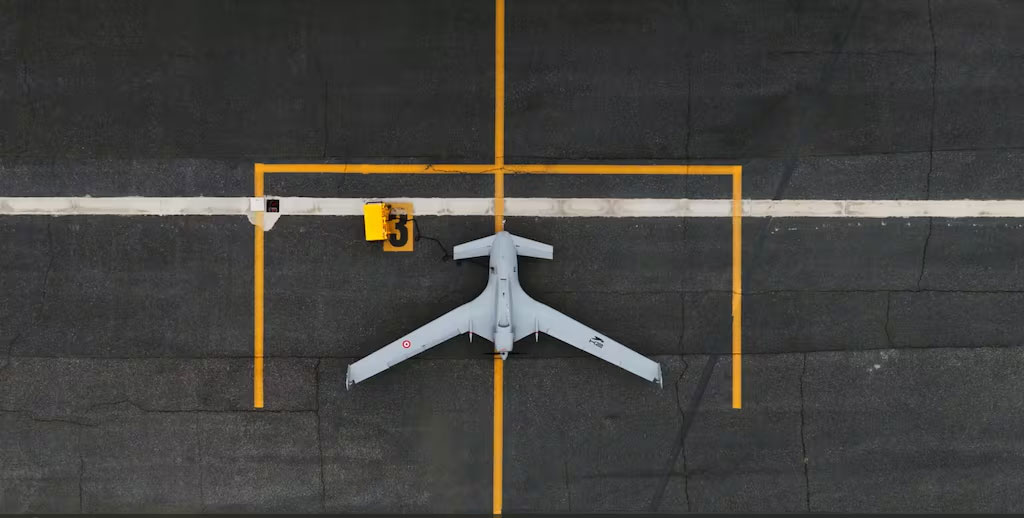
La empresa de defensa turca Baykar ha completado con éxito las pruebas de vuelo de su nuevo dron de ataque kamikaze K2, que como aspecto más destacado presenta la capacidad de operar de manera autónoma en enjambres. Durante los ensayos realizados en Mar 2026, cinco K2 coordinaron diversas maniobras y formaciones complejas utilizando IA y sensores avanzados, sin intervención humana. Con un alcance superior a los 2.000km, puede transportar una carga letal de 200 kg, lo que lo ubica como uno de los UAS más poderosos en su categoría. Además, el K2 está diseñado para navegar con precisión mediante sistemas de visión asistida por IA, en entornos donde la señal GPS está bloqueada o interferida. El objetivo de Baykar es ofrecer una solución de ataque masiva y económica, que reduzca la dependencia de municiones de precisión de mayores costos. Los avances con este nuevo e interesante producto, consolidan el liderazgo de Turquía en la tecnología de drones militares a nivel global.
ISTANBUL — Turkish defense company Baykar announced flight tests of its K2 loitering munition, releasing footage and performance data showing an autonomous swarm formation flying and navigation in GPS-denied environments.
The K2 is a fixed-wing loitering munition measuring 5.1 meters in length and 2.1 meters in height, with a wingspan of 10 meters. The maximum take-off weight is 800 kilograms, of which 200 kilograms is allocated to the warhead payload.
Baykar states that the K2 has a maximum range in excess of 2,000 kilometers, a cruising speed of over 200 km/h, and an endurance exceeding 13 hours.
The K2 carries an electro-optical and infrared gimbal camera, providing day and night reconnaissance and surveillance capability alongside a visual target lock-on function for terminal guidance.
The K2’s navigation architecture is designed to function in conditions where global navigation satellite systems are unavailable or subject to jamming. The platform supports coordinate-based targeting and visual lock-on engagement. Datalink architecture includes both line-of-sight and beyond-line-of-sight satellite communications.
The platform uses terrain-referenced visual navigation — scanning ground features through its gimbal and underside cameras — to derive positional estimates without reliance on external satellite signals.
This approach has become a stated design requirement across a growing number of loitering munitions programs, driven by the prevalence of GPS jamming and spoofing observed in Ukraine and other recent conflicts.
According to Baykar, in the test scenarios, five K2 platforms operating with AI-assisted swarm synergy, used their artificial intelligence, sensors and software to determine their position relative to other aircraft in the swarm, maintaining their place within the formation without error and successfully completing all assigned tasks
Baykar has marketed the K2 as a relatively inexpensive strike option for military forces, with unit cost low enough to permit large-scale fielding and reduce dependence on more expensive precision munitions.
Fuente: https://www.defensenews.com