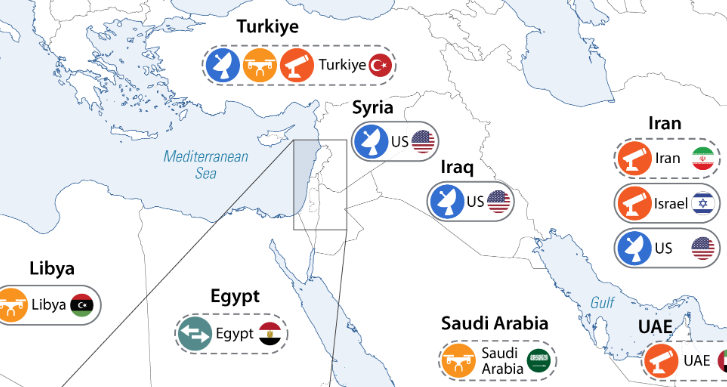
Si bien Israel y Estados Unidos poseen la tecnología más avanzada en este ámbito, países de la región como Irán, Turquía y los Emiratos Árabes Unidos (EAU) también están desarrollando capacidades militares basadas en inteligencia artificial (IA). Turquía está desarrollando sistemas de armas militares con IA de fabricación propia. Los EAU han invertido en empresas armamentísticas israelíes y estadounidenses. E Irán ha afirmado -sin verificación independiente- haber desarrollado misiles guiados por IA.
Militaries across the region are investing in AI-enabled military technologies, often deploying them in conflict to devastating effect. While commercial providers increasingly play an enabling role in military uses of AI, governance frameworks frequently fall short of regulating their activity. There is an increasing need for regulation to maintain the strength of international-humanitarian-law protections for civilians and civilian objects such as schools and hospitals.
These infographics examine the proliferation of military technologies enabled by artificial intelligence (AI) in the Middle East and demonstrate that:
- The United States and regional militaries are increasingly relying on AI-enabled military technologies in combat. They are deploying AI weapons systems and relying on AI-enhanced intelligence, surveillance and reconnaissance as well as command, control and communication functions to enhance battle management and decision-support systems that enable targeting.
- While Israel and the US have the most advanced technology in this regard, regional states such as Iran, Turkiye and the United Arab Emirates (UAE) are also developing AI-enabled military capabilities. Turkiye is developing indigenous AI military weapons systems. The UAE has invested in Israeli and US weapons companies. And Iran has claimed – without independent verification – that it has developed AI-guided missiles.
- Israel’s AI systems are enabled by a diverse network of companies including Israeli- and US-headquartered big-tech corporations. These companies carry out a variety of functions that range from providing cloud services for storing mass-surveillance data on Palestinians and Israel’s lethal targeting algorithms, Lavender and The Gospel, to supplying facial-recognition software and hardware. Some of these companies operate in the defence industry, but many are repurposing commercial technologies for military use.
- In the absence of strict controls, military applications of commercial technology open commercial providers to civil and criminal liability both internationally and at home. Various methods are employed by commercial providers to sidestep regulation including removing prohibitions on military applications of their technology, inserting national-security exemptions in their terms of use and, in some cases, agreeing to a ‘winking mechanism’ to covertly signal to clients if another country’s law enforcement or courts have requested data.
Fuente: https://www.iiss.org