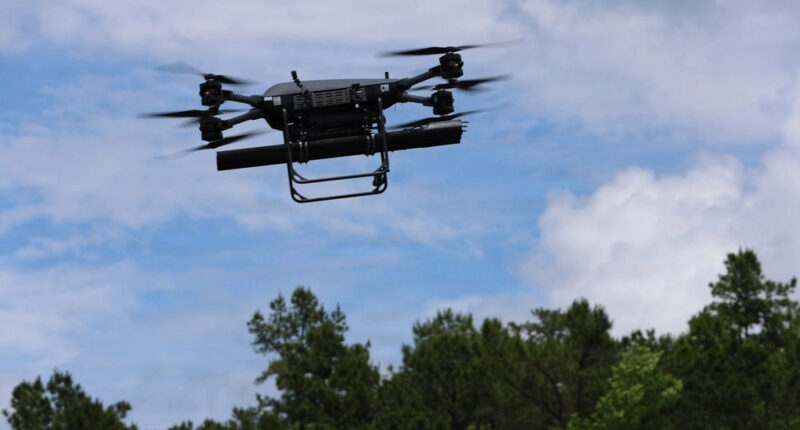
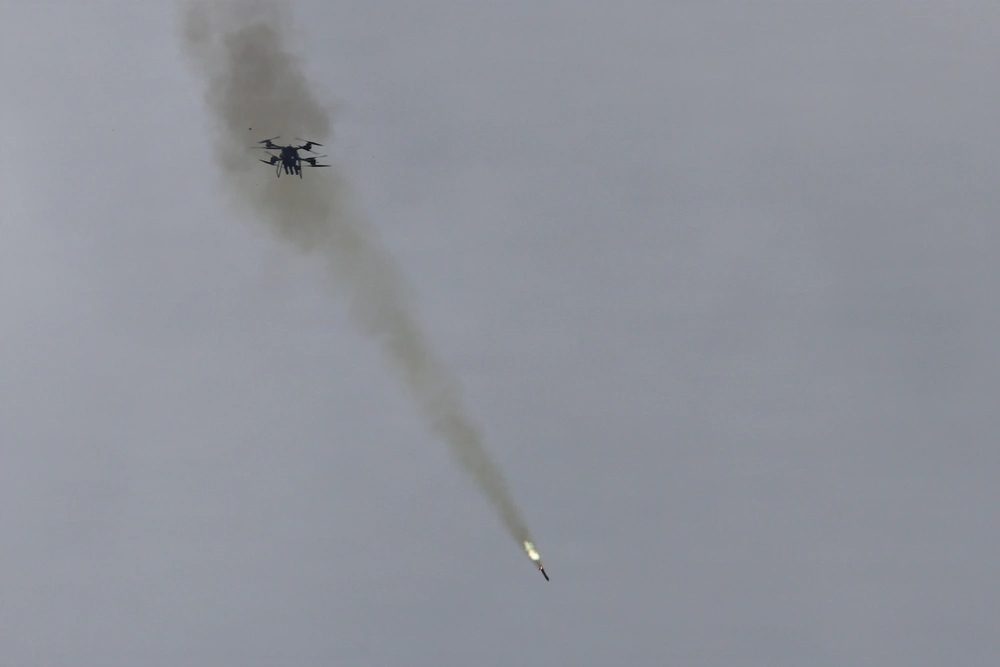
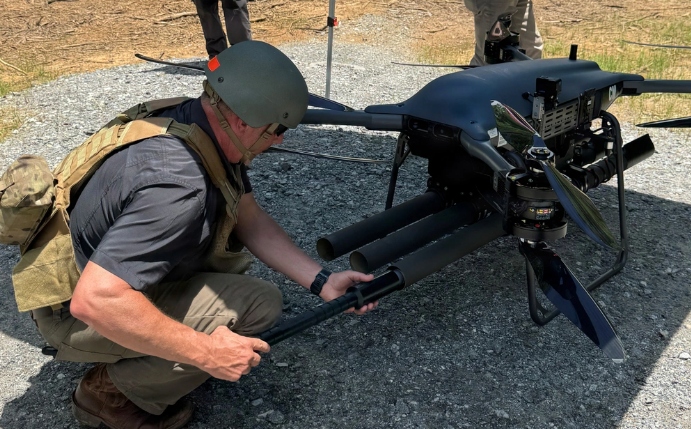
El US Army ha integrado la capacidad de lanzamiento de cohetes, a los drones logísticos empleados para tareas logísticas. Se empleó la plataforma TRV-150, un dron de carga en servicio en el US Army y los Marines, con capacidad de llevar hasta 150 libras (68kg) de peso. A la misma se incorporó el Sistema de lanzadores APKWS (Advanced Precision Kill Weapons System) desarrollado por BAE Systems y un módulo de 3 cohetes de 70mm. En los ensayos realizados en Ft Rucker, se verificó el comportamiento de la plataforma, el módulo lanzador y el software de vuelo y tiro del APKWS, que actualmente se emplea en helicópteros, para adecuarlo así a plataformas autónomas de carga. El presente sistema proporcionará una gran capacidad de fuego de apoyo orgánico a las unidades de nivel batallón e inferiores.
The US Army has integrated rocket firepower into a logistics drone, trialing a reconfigured system equipped with a three-shot launcher.
The test centered on a TRV 150 resupply platform developed by Maryland-based Survice Engineering Company.
It also involved BAE Systems’ FalconWorks integrating its Advanced Precision Kill Weapon System (APKWS), capable of firing 70mm rockets, onto the drone platform.
Conducted at Fort Rucker, the trial assessed how the modified system’s flight control software performs during rocket firing from a horizontally mounted APKWS launcher.
The army said the demonstration was successful, suggesting the concept could reshape how it employs precision munitions in future operations.
“APKWS is currently deployed from Apache and other more exquisite assets, so core and above deployment,” said Clark Dutterer, vice president of business development for Survice Engineering.
“With that same effect on a TRV 150, you’re bringing it down to potentially battalion and below, and making it more expeditionary. You can wrap different [concepts of operations] around it for different units, depending on what their needs may be.”
‘Pickup Truck of the Sky’
The TRV 150, capable of carrying 150 pounds (68 kilograms), is currently in service with the US Army and Marine Corps.
Survice Engineering chief engineer Rob Baltrusch described it as the “pickup truck of the sky,” citing its ability to deliver payloads reliably while maintaining operational flexibility.
The platform features a simplified control interface designed to reduce pilot workload while securing communications through encrypted links.
“It calculates all of the range estimation and takes a lot of the pilot duties away from the Soldier, to where they can literally give it a grid coordinate, wait, and it tells you if it can make it there, delivers the payload, and calculates the route,” Baltrusch said.
Industry-Wide Collaboration
The trial involved collaboration between multiple US Army organizations, including the Combat Capabilities Development Command, the Armaments Center, and the Aviation Center of Excellence.
Officials said the demonstration is part of broader efforts to ensure the army keeps pace with rapidly evolving battlefield technologies.
Some described the effort as an example of delivering faster, more deployable capabilities directly to the warfighter.
“Normally, industry waits for requirements to come out of the government, and they meet that requirement,” Dutterer stressed.
“In this case, we saw that there was something that we could prove out, a new capability, and we didn’t want to wait for a requirement. We self-funded this to go ahead and do that.”
Fuente: https://nextgendefense.com