El presente artículo explora cómo la Manufactura Aditiva (AM /Impresión 3D – 3DP) está revolucionando el diseño de baterías, al permitir estructuras tridimensionales complejas que superan las limitaciones de los modelos planos tradicionales. A diferencia de las baterías convencionales, la AM / 3DP permite crear arquitecturas internas óptimas, que mejoran tanto la capacidad como la velocidad de carga. Esta tecnología facilita la creación de baterías con formas personalizadas, que pueden integrarse directamente en la estructura de dispositivos electrónicos o robots, aprovechando espacios anteriormente considerados inútiles. Este avance es muy importante para la próxima generación de dispositivos portátiles, drones y vehículos eléctricos, ya que contribuye a reducir el peso total y el desperdicio de materiales durante la producción. Una técnica que promete simplificar la fabricación de componentes de “almacenamiento de energía a medida”, adaptándose a las necesidades específicas de cada tecnología.
A superpowered Formula 1 car, a buzzing drone, a soldier’s pack, and a wearable smart device have this in common: They all need batteries. Ideally, those batteries could fit into oddly shaped nooks, curves, and voids, something that today’s cylindrical or rectangular cells struggle to do. Engineer Gabe Elias, who helped design the Mercedes-AMG Petronas racers that won seven consecutive F1 championships, cofounded a startup to 3D print batteries onto surfaces, flowing into those unused spaces in all kinds of devices and vehicles.
The company recently won a US $1.25 million, 18-month contract with the U.S. Air Force to prove its tech’s potential. It joins competitors such as Sakuú, in Silicon Valley, and Germany’s Blackstone Technology, in a race to popularize printed batteries that can conform to various shapes. Soon after Elias cofounded Material Hybrid Manufacturing in 2023, his group realized that their initial pitch—printing batteries in new shapes for passenger cars—was stuck in neutral. EVs, especially bigger ones, don’t have pressing space constraints for batteries. Electric SUVs and pickup trucks from Rivian, where Elias also worked, can fit 7,776 cylindrical batteries into a brawny, 135 kilowatt-hour pack.
So, the company changed lanes to smaller devices with wasted space it could stuff with energy. The Hybrid3D, a proprietary manufacturing platform, can print full-stack batteries in situ: Anode, cathode, separator and casing, with no molds or costly tooling required. The tech eliminates the metal casings, bus bars and other components that hog space in conventional cells. Material’s active battery material can fill voids and follow three-dimensional curves: Think the wing of a drone, or the slender, curling arm of a pair of smart glasses.
“Things are shrinking, so we’re shrinking around it,” Elias says. “Electronics are becoming embedded, consolidated, optimized, and batteries are the only part of that equation that’s being left behind.”
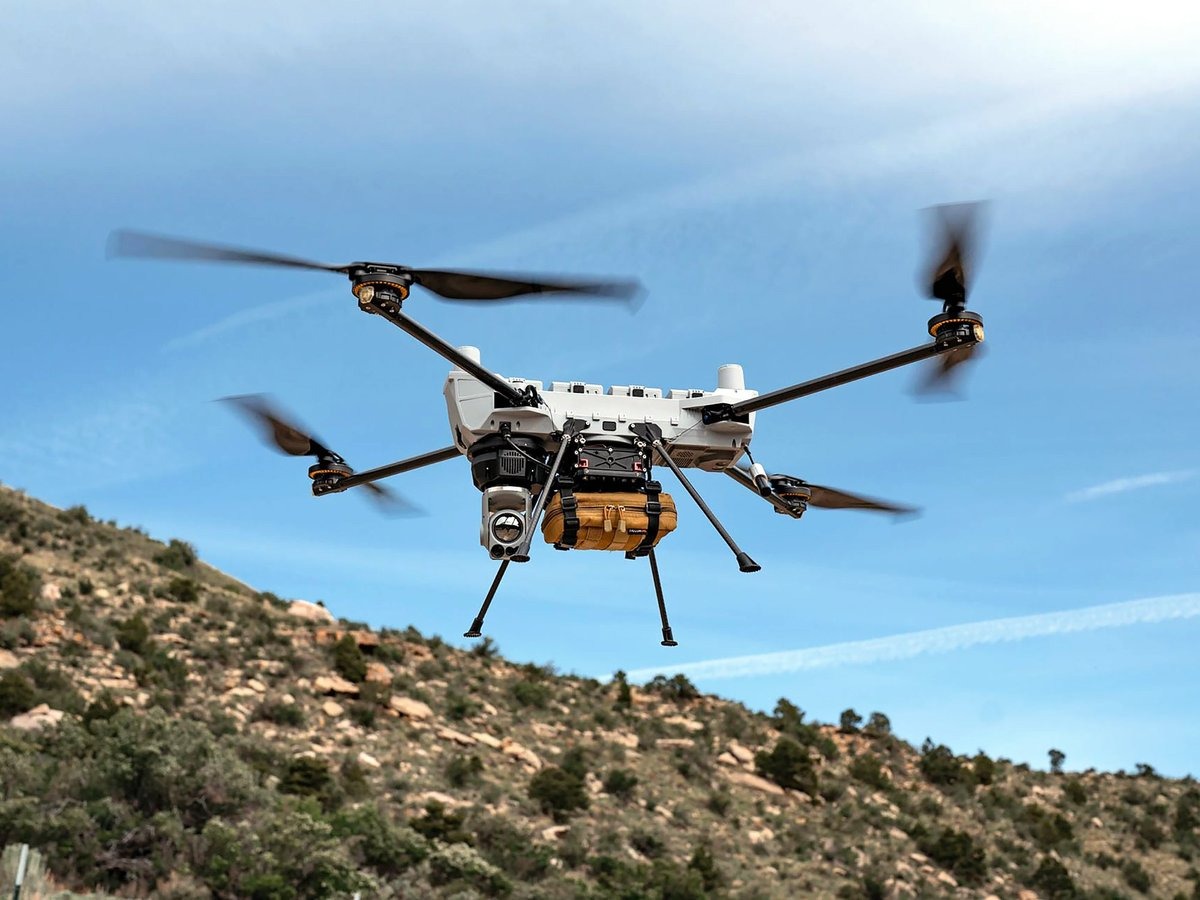
The company has teamed with Performance Drone Works (PDW) to push its tech toward commercialization. For the initial project, the companies will show how much active battery their 3D material can pack into the same modular space that holds 48 cylindrical cells in an existing drone. Even in that simplified, proof-of-concept drone, the printed battery achieves a 50 percent boost in energy density, and uses 35 percent more available volume.
“That gives you a bunch of options,” Elias says. “You could either fly 50 percent farther, or decrease the size of the battery pack, fit more payload, and cover the same distance.”
Fit for purpose
Next-gen designs could boost those gains by dispersing battery material around drone frames, electric motors, or other surfaces. Notoriously heavy military backpacks—stuffed with bulky, square batteries—could be lighter and ergonomically shaped. Military helmets could directly integrate batteries that power head-mounted gear.
When he was still at Mercedes, Elias tried to wrap conventional cells around a driver’s seat to improve the layout. Even in the rarefied realm of F1 racing, where top teams spend hundreds of millions of dollars a year in the service of speed, Mercedes simply gave up.
“We ended up stopping the project, just knocking our heads against the wall because it’s so complicated to take these little cylindrical cells, wedge them into spaces and tie them together in the configuration you want,” he says.
Material’s batteries, he says, are the natural evolution of carbon fiber or other composite structures in automobiles, including “cell to pack” construction that eliminates modules and makes batteries integral parts of structures.
“We’re turning energy storage into a subsystem, just like all the other subsystems on a car,” Elias says.
Material’s first commercial-scale printer’s bed measures 550 by 350 millimeters, with plans to greatly expand that surface. Its tech is essentially a hybrid of direct ink printing and fused deposition modeling, two of several techniques being developed by companies vying to bring these energy sources to market.
Critically, the tech would allow batteries to go from prototype to printing, with no need for expensive, time-consuming retooling. Material’s printer platform can already handle a variety of chemistries and formats with simple changes in materials and software coding, he says.
“We’ve printed NMC 811 and NMC 111, LFP and lithium-titanate oxide (LTO), to name a few,” Elias says. “We’re chemistry-agnostic.”
Material’s cells currently use liquid electrolyte, added via an infusion process, but the company has a working road map toward solid-state designs. Challenges include tuning battery materials to flow properly from printer nozzles; and to deposit that material in uniform, repeatable layers, roughly 100 to 150 micrometers thick, to ensure high quality and yields.
“Batteries really live and die by layer thicknesses,” Elias says.
Elias notes that Apple and other companies are investing massive amounts of money to create conformable batteries, such as the L-shaped batteries in some iPhones, but are using costly and limited traditional methods. And with consumer electronics giants fighting to popularize wearable devices, printed batteries are an enticing solution for their packaging and power needs. Elias points to Apple’s Tim Cook, who has gone from an AR skeptic to a champion of smart glasses. But consumers won’t really bite, he believes, until the form factor says “Ray-Ban stylish” rather than “four-eyed dork.”
“I want the connectivity and usability, but I don’t want to look stupid, or I’m just going to pull out my smartphone,” he says. “We see this as a proliferated application where everyone and their mother is going to have one of these devices.”
If companies can manage to print batteries the way office workers print a document, the technology would replace much of the costly tooling, dedicated factory production lines and time-consuming processes of conventional batteries. Those printed batteries could then compete on cost across the entire market, Elias says, from single cells to complex multicell packs, where prices can range from $400 to $3,000 per kilowatt-hour.
“The more complex the pack, the more value we capture from part consolidation and system integration, so those applications actually carry higher margins for us,” he says.
Fuente: https://spectrum.ieee.org