Corea del Sur (CS) está impulsando la integración de la Inteligencia Artificial física (sistemas robóticos y no tripulados) en sus FFAA para modernizar la defensa nacional y contrarrestar la escasez de personal causada por el descenso demográfico. A través de inversiones masivas, como el plan de US$ 3,2 billones del 2026, el gobierno busca posicionarse como líder global en esta materia. CS cuenta con ventajas clave: una moderna y flexible capacidad de producción, un importante ecosistema científico-tecnológico, un gran índice de densidad robótica industrial y el dominio del desarrollo y fabricación de componentes esenciales como semiconductores y baterías. Sin embargo, enfrenta desafíos como la competencia de precios con China en hardware y la lentitud de sus procesos de adquisición militar. A pesar de estos obstáculos, el avance surcoreano ofrece a EE.UU. y Europa, una alternativa interesante para reducir su dependencia de las cadenas de suministro chinas en tecnología militar avanzada.
South Korea is rapidly incorporating physical artificial intelligence (AI) into its armed forces to modernise its capabilities and address a growing shortage of military personnel. Seoul enjoys several advantages that could enable it to become a global leader in this field. It has high capacity for large-scale manufacturing, a growing start-up sector rooted in an advanced scientific and technological base, strengths across the broader physical-AI ecosystem, and enjoys a leading position in the use of robotics in civilian manufacturing. Its domestic access to critical components of uninhabited ground vehicles and robotics also creates opportunities to help European and US firms reduce their dependence on Chinese suppliers.
Accelerating adoption
President Lee Jae-myung’s administration has made AI investment a national priority and aims to establish South Korea as one of the top three AI power globally and the world leader in physical AI. In June 2026 it announced the ‘Three Mega Projects’, a large-scale investment plan that will see US$3.2 trillion invested over ten years in three priority areas: semiconductors, AI data centres and physical AI.
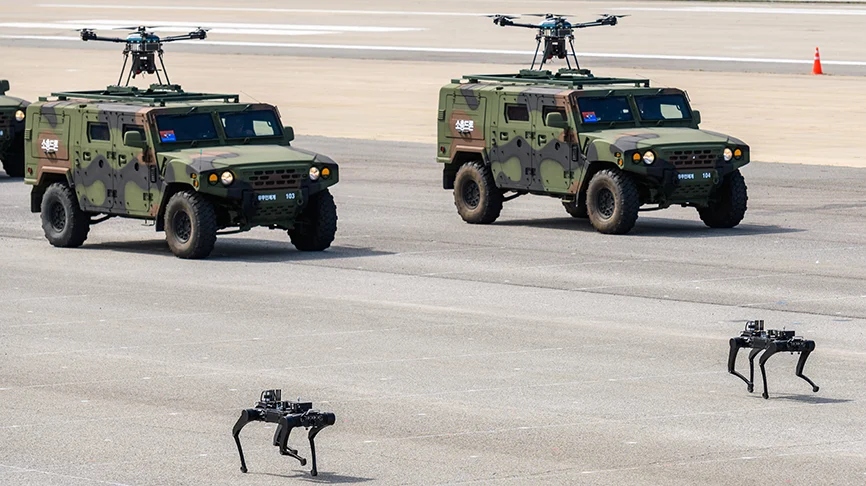
Military physical AI – that is, AI-enabled uninhabited and robotic systems – is becoming an important focus of Seoul’s efforts to modernise its armed forces. In August 2024, the South Korean Army test-deployed quadruped robots that were developed by the Defense Rapid Acquisition Technology Research Institute in collaboration with Hyundai Rotem and Rainbow Robotics for counter-terrorism operations. It also plans to deploy Hanwha’s multipurpose uninhabited ground vehicle between 2027 and 2028. The system will perform a range of missions, including ammunition resupply, the transport of supplies and casualties, and surveillance and reconnaissance. In July 2026, the South Korean Navy conducted its first test of a humanoid robot serving as a helmsman.
Military physical AI will increasingly undertake dull, dirty and dangerous tasks, reducing risk to military personnel and improving efficiency. For South Korea, its adoption is also an urgent strategic necessity due to a widening personnel gap caused by demographic decline. The number of eligible conscripts for active duty has fallen by approximately 30% over the past decade, from 455,551 in 2016 to 322,674 in 2025, and this decline is expected to continue. In response, the Ministry of National Defense plans to reduce the number of troops stationed at general outposts along the front line near the Demilitarized Zone by 75%, from approximately 22,000 to 6,000. It intends to compensate for this reduction by introducing an AI-enabled border-security system integrating uninhabited aerial systems, multi-legged combat robots and other assets through an AI-based sensor network.
Competitive advantages
For a number of reasons, South Korea has the potential to emerge as a global leader in the military applications of physical AI. Its manufacturing strength is a major asset. As one of the world’s leading manufacturing economies, with large conglomerates in the automobile and electronics sectors, South Korea boasts the industrial capacity, technical expertise and domestic supply chains needed to mass produce uninhabited ground vehicles and robotics. Moreover, it has a dense manufacturing ecosystem of small- and medium-sized enterprises that supply components and technologies to larger firms. This industrial base can reduce production costs, shorten development cycles and facilitate the rapid scaling of new systems. It also strengthens supply-chain resilience. As South Korean robotics firms largely use domestic components, they are less vulnerable to external disruptions. This combination of manufacturing scale, supplier depth, and domestic production capacity gives Seoul a significant advantage in developing and fielding military physical AI at speed, scale and competitive prices.
South Korea also has strengths in science and technology, particularly in engineering. Researchers frequently develop proprietary technologies and then commercialise them through start-ups, creating a pipeline from academic research to industrial application. For instance, Raibo 2, a quadruped robot, was developed by Raion Robotics, a start-up founded by a mechanical-engineering professor at the Korea Advanced Institute of Science and Technology (KAIST), one of the world’s leading universities in these fields. Raibo 2 can walk continuously for 43–67 kilometres (depending on the terrain) on a single battery charge, reportedly further than any comparable robot currently available. The research team’s proprietary dynamics simulator, which enabled the robot to learn an optimal walking pattern to minimise energy loss, made this performance possible. South Korean start-ups often collaborate with large corporations that have the capital and manufacturing capacity required to scale production. For example, in December 2024, Samsung Electronics became the largest shareholder in Rainbow Robotics – also founded by KAIST researchers – combining the technological agility of the start-up with the resources and production capabilities of a major conglomerate.
Another factor is the strength of South Korea’s broader ecosystem, particularly in batteries and advanced semiconductors. As a major producer of electric vehicles and lithium-ion batteries, it has the capability to improve uninhabited systems and robots’ operating times, power outputs and energy efficiency. The country is also a global leader in memory semiconductors. Samsung Electronics and SK Hynix produce advanced memory chips that enable AI systems to store and retrieve the vast quantities of data required for training and operation. Together, the two companies account for more than 80% of the global high-bandwidth-memory (HBM) market. This strength is important not only for training and operating South Korean physical-AI applications but also for positioning the country as a key part of the global AI ecosystem. Amid tight supplies of advanced memory chips, South Korea’s semiconductor capabilities give it considerable leverage in forming partnerships with leading international AI companies. In October 2025, OpenAI announced new strategic partnerships with Samsung and SK Hynix under its Stargate initiative, in which the two companies agreed to expand their production of advanced memory chips. OpenAI and its South Korean partners have also agreed to explore the development of next-generation AI data centres in the country. More recently, in July 2026, SK Group and NVIDIA announced a partnership expected to generate more than US$500 billion in aggregate commercial activity, which would see SK Hynix supply and jointly develop HBM with NVIDIA, with the latter providing graphics-processing chips and AI-factory architecture.
South Korea’s leading role in the use of robotics in civilian manufacturing could also support its development of military robots. According to the World Robotics 2025 report, South Korea had 1,220 industrial robots per 10,000 employees, the highest robot density in the world and far above the levels recorded in the US (307), China (166) and the average for Western Europe (267). Advances in commercial robotics – including technology, technical expertise and manufacturing capacity – will generate significant spillover benefits for the development of military robots.
Constraints on ambitions
South Korea’s push to become the world leader in military physical AI faces several challenges. The country continues to lag behind the US and China in frontier AI models. Although Seoul has considerable strengths in advanced manufacturing, Chinese firms can produce uninhabited systems and robots and key components at substantially lower cost. Given China’s economies of scale, South Korea is unlikely to compete on price alone, and will need to strengthen other areas of competitiveness as it seeks to expand into overseas markets. Success in these markets could, in turn, enable South Korean firms to increase production volumes and reduce unit costs. In addition, the government’s military acquisition process, which is typically lengthy and cumbersome, remains an obstacle to the rapid deployment of AI applications. Although Seoul has introduced expedited pathways for selected cutting-edge systems, these currently focus primarily on prototypes and trial deployments rather than streamlining the mass-production and acquisition process across the board.
Potential contributions to security partners
South Korea’s advances could contribute to the development of physical-AI capabilities among its security partners. Robotics firms worldwide, including those in the US and Europe, remain heavily dependent on Chinese components. Commercial uninhabited and robotic platforms and their broader supply chains, including those associated with US models such as NVIDIA’s Isaac GR00T and Tesla’s Optimus, use Chinese components. Europe’s dependence on Chinese hardware is more deeply entrenched. As one European expert observed: ‘We would be naive to think that we can really achieve sovereignty and independence from Chinese hardware supply chains in robotics.’
The United States’ and Europe’s reliance on China in military applications of AI poses significant security risks. China could restrict access to essential components, delay repairs and replenishment or, more seriously, compromise hardware and software in ways that disrupt military operations. Concerns that Chinese-made components could enter military supply chains recently led the US House of Representatives to include a provision in its version of the fiscal year 2027 National Defense Authorization Act that would prohibit the US military from procuring Chinese-made humanoid robotic systems. This risk is clear to Europe, where countries view China as a ‘strategic competitor’ and are therefore seeking to limit cooperation with it in defence- and security-related technologies, as noted by an International Institute for Strategic Studies Research Paper. Against this backdrop, South Korea’s advancement in military applications of physical AI could help reduce US and European dependence on Chinese supply chains. In doing so, it could strengthen supply-chain resilience and reduce their strategic vulnerabilities vis-à-vis China.
Fuente: https://www.iiss.org